Monday, 25 May 2009

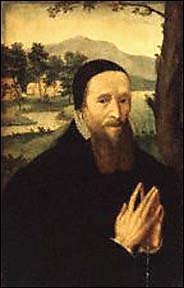
Nicholas Owen--Oxford Dictionary of National Biography


This is the Oxford Dictionary of National Biography's entry for Nicholas Owen.
For a previous post on Owen, click here

Owen, Nicholas
[St Nicholas Owen, called Little John, Little Michael] (d. 1606), carpenter and Jesuit lay brother, was born in Oxford, probably in St Peter le Bailey. On 2 February he was apprenticed for eight years to William Conway, an Oxford joiner. He sometimes used the aliases Draper and Andrews. He had three brothers: John (b. 1560), a seminary priest; Walter (1568–1591), who died as a deacon at the English College in Valladolid; and Henry, who was apprenticed to the university printer Joseph Barnes and later ran secret presses in the Clink prison in London and in Northamptonshire. All four may have been sons by a previous marriage of Walter Owen (d. 1607), a carpenter who leased 3 Castle Street from Magdalen College from 1566 onwards and whose wife Agnes (d. 1609) was a recusant in 1603–4.

In 1588 Nicholas Owen became servant to the Jesuit superior Henry Garnet. From then on
his chief employment was in making of secret places to hide priests and church stuff … in all shires and in the chiefest Catholic houses of England … of several fashions in several places, that one being taken might give no light to the discovery of another. (Catholics under James I, 182–4)
From documentary and architectural evidence it is possible to identify the characteristics of his work: a liking for sites away from outside walls; an ability to think in three dimensions and in curves; and the inventiveness noted by John Gerard and not shown by some other builders. Surviving examples include those at Oxburgh, Norfolk (1589?); Baddesley Clinton, Warwickshire (1588–91); Braddocks, Essex, and Sawston, Cambridgeshire (both 1592–3); Scotney Old Castle, Kent (by 1598); and Harvington, Worcestershire (about 1602).

On 23 April 1594 Owen was arrested with John Gerard at a house in London. He was tortured, but gave nothing away and was released for ‘a good round sum of money’ (Catholics under James I, 183). In October 1597 he helped Gerard to escape from the Tower of London. About 1600 he became a Jesuit lay brother and an accident with a restive horse left him with a slight limp. Both he and Henry Garnet were finally taken at Hindlip, Worcestershire, during a twelve-day search in January 1606 when ‘eleven secret corners and conveyances were found in the said house’ (BL, Harleian MS 360, fol. 101r). Owen and a companion, Ralph Ashley alias Chambers, were starved out of a hide in the long gallery on Thursday, 23 January, after four days with one apple to eat between them. Owen was imprisoned first in the Marshalsea and then in the Tower, where he was ruthlessly tortured despite suffering from a rupture. He died of the torture on the night of 1–2 March; according to Gerard, ‘his bowels gushed out together with his life’, and the official version was that he had ‘ripped up his own belly with a knife without a point’ (BL, Stowe MS 168, fol. 364r). According to Henry More he was buried within the Tower, in ipsa arce (Historia provinciae Anglicanae, 1660, 322). He was beatified by Pope Pius XI on 15 December 1929 and canonized by Paul VI on 25 October 1970.

Michael Hodgetts

Sources

The condition of Catholics under James I: Father Gerard's narrative of the Gunpowder Plot, ed. J. Morris, 2nd edn (1872) · John Gerard: the autobiography of an Elizabethan, trans. P. Caraman, 2nd edn (1956) · J. Morris, Life of Fr John Gerard (1881) · M. Hodgetts, Secret hiding-places (1989) · M. Hodgetts, ‘The Owens of Oxford’, Recusant History, 24 (1998–9), 415–30 · A. Hogge, ‘Closing the circle: Nicholas Owen and Walter Owen of Oxford’, Recusant History, 26 (2002–3), 291–300

Archives

TNA: PRO, two brief confessions of 26 Feb and 1 March 1606, SP 14/216/ii/192, 194


Likenesses

engraving, repro. in M. Tanner, Societas Jesu usque ad sanguinis et vitae profusionem militans (Prague, 1675), 74


Thursday, 21 May 2009

שבירה ותיקון

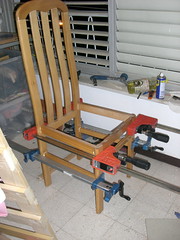
And bend your force, to break, blow, burn, and make me new I got another 'commission', recently, and that was to repair some dining room chairs for some friends. This posting is a little photo journal of the process. I thought it was a bit ironic that in order to fix the chairs, i had to break them. Obviously, i was thinking of Donne:

That I may rise, and stand, o'erthrow me, and bend
Your force, to break, blow, burn, and make me new


Well, his Holy Sonnet XIV, as well as classic kabbalistic imagery, which, in keeping with our previous discussions about law, oddly seems to be applied by Launcelot Andrewes in his discussion about the fall of man:
Text not available

from A Pattern of Catechistical Doctrine (1642)
And also, i suppose, i was thinking of Andrewes's friend Richard Hooker who discusses the concept of 'compatible variety' along similar lines:
A more dutifull and religious way for us were to admire the wisedome of God, which shineth in the bewtifull varietie of all things, but most in the manifold and yet harmonious dissimilitude of those ways (III.xi.8)
Click here for Rowan Williams's (the current Archbishop of Canterbury) excellent Richard Hooker Lecture (2005) at the Temple Church, in which he manages to explain, and, perhaps more impressively, apply Hooker's philosophy to modern multi-cultural societies.

Anyway, having established the harmonious Gross glue in the mortises dissimilitude of the chair pieces, the glue had to be removed from the mortises. See how old and nasty looking the glue is?

I have my cousin Otto and my uncle Kees to thank for the next step. When i was in Amsterdam a few months ago, i saw a dremel for sale near the Cuyp markt. I totally needed a dremel and told Otto of the price and bits, etc, and headed out and bought it. When i brought it home, i proudly showed it to my cousin Kathelijne and my aunt, Saskia.'Cleaning with dremel and chiselIsn't it cute?!' I asked them. They agreed it was indeed a cute little thing with a plethora of cute little bits. But they wanted to know why i was making such a strange (albeit, cute) purchase. 'Oh, everyone needs a dremel, really,' was my reply, which was vigorously backed up by both Otto--'Yes, it's a common tool, and everyone has one' (he has the coolest job ever--restoring buildings) and Kees 'Oh, you can do everything with them' (he is a bronze sculptor). 'Well, what do you do with it?', came the question. Crap, i actually have no idea. Maybe i'll know what to do with it when Otto or Kees explains it. 'Well...you...' [hesitation] 'There are many...' And they both looked at each other, laughed, and admitted that they actually can't quite recall the last time they used their dremels! Anyway, the chisel pictured is one from Otto's grandfather Yeah, i did--the headlamp, baby!(i still need to finish the handle).

I took this photo to show my parents that i do, indeed, wear safety equipment (Tali, don't mock the headlamp!). Plus, i felt like a dentist. Cool-maybe i'll study dentistry. Although, now that i think of it, i'm not so comfortable with someone operating a rotary tool in my mouth...

Scraping glue off the tenonsThe reason for the mask is that when i used the dremel, the glue smelled like a rotting dead animal. For real. There's no way it's hide glue, right? Obviously, the tenons were also covered in old glue, so i sliced off chunks of nasty, smelly glue.

One final check CIMG0854

And then the ever-stressful gluing Actiion shot-glue


And finally, clamping:

Hope it holds!


Tuesday, 19 May 2009

First Commission: A Coffee Table for Sivan

Just a brief break from Hooker. Well, on the blog that is. My friend Sarah (who lives in New York sent me the following email:
Can you take some pictures of some of your supposed "woodworking"? I have no idea what the hell any of this is!
So i am posting some photos of my first commission--a mission-style coffee table that i built about a year ago. I didn't really have a shop (still don't) so i had to work on my counter. It's not an ideal workspace, but it works pretty well, especially when your room mates are not home! The table had a little curve to it to soften the boxy mission-style. I shaped the aprons with a block plane, although a jigsaw could have done the trick. At the time, my brother Uri was living with me for a bit, and he got into it as well . You can see the apron beginning to take form here: Here is the frame glued up Here you can see the curves a bit more--so it's a modern take on the mission style (obviously from a plan...) And here, you can clearly see that in my exhaustion, i actually glued the bottom rail in upside down! You can also see its twin, my first table (and the one that got me the commission) behind it.
Apologies for the format--i have not been able to figure out a normal way to do this.

Thursday, 14 May 2009

The Good, the Bad, and the ?!?!: Hooker on Chukim--part 1 (because it's just too long)

The book of Leviticus is a code of conduct required of Israel as a result of the establishment of a relationship with God in the books of Genesis and Exodus. More or less. There's loads of stuff in here; rules about moral, sexual, and sacrificial conduct, Sabbath, slavery, harvest, social justice, etc. Most of us nod enthusiastically when reading about many of these laws (like the prohibitions of stealing, cheating, and lying--19:11). And then there are those, called chukim, or divine decrees that just seem...random (like mixing wool and linnen--19:19). Richard Hooker, the 16th century divine (basically the father of Anglicanism) addresses these unusual laws in the context of his discussion about the reformation of laws or church practises:
It may so fall out that the reason why some lawes of God were given is neither opened nor possible to be gathered by the wit of man. As why God should forbid Adam that one tree, there was no way for Adam ever to have certainely understoode. And at Adam’s ignorance of this pointe Satan tooke advantage, urging the more securely a faulse cause because the true was unto Adam unknowen.
Why the Jewes were forbidden to plowe their grounde with an oxe and an asse, why to cloth them selves with mingled attire of wooll and lynnen, both it was unto them, and unto us it remaineth obscure. Such lawes perhaps can not be abrogated saving onely by whome they were made: because the intent of them being knowne unto none but the author, he alone can judge how long it is requisite they should indure.
(Of the Laws of Ecclesiastical Polity, Book III, Chapter 10.1)

Obviously Hooker, like most Christians, would hold that these laws were abrogated by Jesus. However, Hooker's belief in Divine law as moral and just, despite humanity's inability to fathom the reasons, led Hooker to differ from scholars such as John Selden, Dionysius Vossius (a pupil of Menasseh Ben Israel), and John Spencer. It also underscores Hooker's own puzzling relationship with his go-to guy on the subject of the 'Israelite State'--Maimonides. In The Guide of the Perplexed (III:37), Maimonides explains the reason for the prohibition on shaving (Leviticus 19: 27, 28) as follows:
The shaving of the corner of the head and of the corner of the beard has been forbidden because it was a usage of idolatrous priests. This is also the reason for the prohibition of mingled stuff, for this too was a usage of these priests, as they put together in their garments vegetable and animal substances bearing at the same time a seal made out of some mineral..." (trans. by Shlomo Pines, p. 544)
In Book IV, Hooker pretty explicitly parts ways with Maimonides, who had been his authority until then:
That shaving therefore and cutting, which the law doth mention, was not a matter in itself indifferent, and forbidden only because it was in use amongst such idolaters as were neighbours to the people of God: but to use it had been a crime, though no other people or nation under heaven should have done it saving only themselves. As for those laws concerning attires : " There shall no garment of linen and wool- Levit. len come upon thee ;" as also those touching food and diet, wherein swine's flesh, together with sundry other meats, are forbidden; the use of these things had been indeed of itself harmless and indifferent: so that hereby it doth appear, how the law of God forbad in some special consideration, such things as were lawful enough in themselves. But yet even here they likewise fail of that they intend. For it doth not Dent, appear that the consideration, in regard whereof the law forbiddeth these things, was because those nations did use them. Likely enough it is, that the Canaanites used to feed as well on sheep as on swine's flesh; and therefore, if the forbidding of the latter had no other reason than dissimilitude with that people, they which of their own heads allege this for reason, can shew I think some reason more than we are able to find why the former was not also forbidden. Might there not be some other mystery in this prohibition than they think of? Yes, some other mystery there was in it by all likelihood. For what reason is there, which should but induce, and therefore much less enforce us to think, that care of dissimilitude between the people of God and the heathen nations about them, was any more the cause of forbidding them to put on garments of sundry stuff, than of charging them withal not to sow their fields with meslin; or that this was any more the cause of forbidding them to eat swine's flesh, than of charging them withal not to eat the flesh of eagles, hawks, and the like? Wherefore, although the church of Rome were to us, as to Israel the Egyptians and Canaanites were of old ; yet doth it not follow, that the wisdom of God without respect doth teach us to erect between us and them a partition-wall of difference, in such things indifferent as have been hitherto disputed of.
Eagles, hawks, and the like? Mmm...and now the forbidden fowl must be tasted:


Hey! Pay attention!

As I was saying, quite simply, it would seem that Hooker is against the idea of God telling people what to do 'because i told you so'. He argued against the voluntarist position of the Puritans who felt that law was dependent on God's will alone. In The Problem of Pain, CS Lewis meditates on the relationship between religion and morality:
It has sometimes been asked whether God commands certain things because they are right, or whether certain things are right because God commands them. With Hooker, and against Dr. Johnson, I emphatically embrace the first alternative. The second might lead to the abominable conclusion (reached, I think, by Paley) that charity is good only because God arbitrarily commanded it—that He might equally well have commanded us to hate Him and one another and that hatred would then have been right. I believe, on the contrary, that ‘they err who think that of the will of God to do this or that there is no reason besides His will'

Ok-that's all for part 1. Just thinking aloud. Thanks for reading. And if you didn't--it will get better soon (not in part 2--just when i get unstuck and off this topic).


Thursday, 7 May 2009

And...we're back

When, for some inexplicable reason, i finally acknowledged that i would rather get lost in a sandstorm with my eyes taped open than finish my chapter on Hooker, i knew i had to make a little project. You know, to get that out of the way.

It's called a mezuzah, a piece of parchment containing the Shema (the affirmation of God's unity) in fulfillment of the Deuteronomic injuction And you shall write them on the entryways of your dwellings and your gates. It's basically a shoutout to God, and in Egypt, insurance that the first-born Israelites would not be slain.

To be precise, my project is actually a case for the mezuzah. I had a zebrawood pen blank i got a Rockler ages ago and decided that the stripes made a natural ש or shin, the twenty first letter of the Hebrew alphabet, and generally written on the mezuzah case. For some wild stuff on shin, click here.

I used my new favourite chisel from my cousin, Otto (i will make a separate post about the tools from Otto) to make room for the parchment in the back and then rubbed some polyurethane and paste wax on it and that was pretty much it. I used velcro to affix it to the door jamb.


Hmm...i wonder if Hooker mentions anything about mezuzahs. Oooh...Guess I'm back to work...

Tuesday, 5 May 2009

Nationale Bevrijdingsdag 'Liberation Day--Inside Story of Eindhoven Told by Dutch Parents'


They are greeting us with the V-sign or with their thumbs up. We are on the road to victory! And when the column stops for a minute because apparently the narrow streets further on hold up the traffic we shake hands with those men and we are able for the first time in all those years to speak to an Englishman. Have we ever been so thankful towards complete strangers? ‘Thank God you have come at last.’ ‘It is good to be true.’ They are laughing all the time and they tell us that only a few miles from Eindhoven they had to fight hard when we were sleeping peacefully. It is a curious world, indeed! ‘Jerry gave us hell on the Dutch border,’ they say, ‘but here we are, anyway’. They ask us how the Germans treated us and they can't believe what we tell them. They shake their heads and say, ‘Well, that’s all over now. You are free again.’

Free! Think about it, children! That one can say what one wants; that we are going to have decent papers again and all the rest of it. I am sure that we shall only gradually get used to it.

They are very generous, those English troops. They distribute cigarettes among the population. Those first English cigarettes after all those years! We snatch the English papers from their hands. They just laugh at those people who are so happy with all those very simple things. At the cars which are pulled up at the roadside, groups of children are pushing and hustling and begging the soldiers for their autographs. They are quite willing to give them not once but hundreds of times. I asked one of them how many times had he done that. He answered, ‘Numerous times. Yes, it’s being like Gary Cooper.’

For us this entry has something unreal. Such a mad enthusiasm we had not thought possible. But for the troops, too, this entry must be unforgettable with the radiant evening sun over all those flags and pennants flying from the houses. We have been watching all this together with you, children, and we told you that those men were our friends. At times there were touching moments and one felt a lump rise in one’s throat. Mummy is holding you high, Saskia, and you shake hands with a soldier on top of a huge tank, and very shyly, with a very small voice, you say to him the first words in English you ever spoke, ‘Good luck to you!’ And smiling, the answer comes back, ‘Thanks, kids. We’ll need it.’ Yes, they’ve got to carry on. From the bottom of our hearts we wish them God speed.

When it is quite dark we go home again tired out but happy as never before. With friends we spend the rest of the evening, talking about this gigantic war machine about which we heard so much over the wireless and which at last we were allowed to see with our own eyes.


As published by The Examiner, Saturday, May 12, 1945
* 6 years to the date of this publication, the Schippers had another daughter, Celine--my mum.