Just some drivel from a PhD student in 17th century English literature. Masoret is Hebrew for tradition; Masor is also the Hebrew word for saw. Since i hope to be learning and blogging about traditional woodworking (amongst sundry other things), i thought it was an apt play on words. Before you ask, yes, i have a glamorous social life.
Tuesday, 30 November 2010
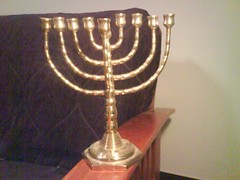
Westerkerk Rimonim (Finials)
Sunday, 11 July 2010
Revius and Donne: Poets of the Bible
'Hy Droegh Onse Smerten' (1630 in Over-Ysselsche Sangen en Dichten)
T'en sijn de Joden niet, Heer Jesu, die u cruysten,
Noch die verradelijck u togen voort gericht,
Noch die versmadelijck u spogen int gesicht,
Noch die u knevelden, en stieten u vol puysten,T'en sijn de crijghs-luy niet die met haer felle vuysten
Den rietstock hebben of den hamer opgelicht,
Of het vervloecte hout op Golgotha gesticht,
Of over uwen rock tsaem dobbelden en tuyschten:Ick bent, ô Heer, ick bent die u dit hebt gedaen,
Ick ben den swaren boom die u had overlaen,
Ick ben de taeye streng daermee ghy ginct gebonden,De nagel, en de speer, de geessel die u sloech,
De bloet-bedropen croon die uwen schedel droech:
Want dit is al geschiet, eylaes! om mijne sonden.
In English ( i grabbed the translation here):
He carried our sorrows. It is not the Jews
alone, Lord Jesus, that had you crucified;
betraying you, dragging you to the court,
hating your guts, spitting in your face,
binding you, tattooing you with bruises.
Nor only the soldiers
who with their ready fists
raised the reed, lifted the hammer high,
fixed the cursed wood at the place of the skull
and squabbled, dicing for your coat.
It's me, my God, me who did this to you.
I am the heavy tree that bore you down,
the cord that cut you mercilessly. Me.
The nail and spear. The whip they slashed you with.
The crown of blood you wore upon your brow.
Oh, all this happened on account of my own sin.
And here is of course Donne's Holy Sonnet XI (written 1609-1611?):
Spit in my face, you Jews, and pierce my side,
Buffet, and scoff, scourge, and crucify me,
For I have sinn'd, and sinne', and only He,
Who could do no iniquity, hath died.
But by my death can not be satisfied
My sins, which pass the Jews' impiety.
They kill'd once an inglorious man, but I
Crucify him daily, being now glorified.
O let me then His strange love still admire ;
Kings pardon, but He bore our punishment ;
And Jacob came clothed in vile harsh attire,
But to supplant, and with gainful intent ;
God clothed Himself in vile man's flesh, that so
He might be weak enough to suffer woe.
Monday, 28 June 2010
The Character of Holland...According to the English
who but such an Hebrew Jew as you, would, after an honest man hade made so full and voluntary Restitution, not yet have been satisfied without so many pounds of his flesh over into the bargain.This is actually in the context of a debate rooted in Hebraism, so the insults get way more interesting than that (check out Rosenblatt's book on Selden, chapter 5).
Unsurprisingly, in the early modern period, religion was a source of conflict. The English disapproved of the Dutch pluralistic society, which was rooted in Republican sensibilities; this disregard for order and hierarchy was dangerous. The Dutch took the reformist call for personal autonomy in interpreting Scripture too far:
They are generally so bred up to the Bible that almost every Cobbler is a Dutch doctor of divinity...yet fall those inward illuminations so different that sometimes seven religions are found in one family.' (Schama)And finally, here is the poem. Incidentally, if you're Dutch and Jewish, well, Marvell will offend you in one form or another! ;-)
Friday, 11 June 2010
Eliav Digs Dutch Designers
Below is a CGI animation of the chair:
Gerrit Rietveld chair from Max Philip on Vimeo.
For Anthony C. Romeo's interesting article on Rietveld's chair and the unification of motion and rest, click here. It's a great, short read. Andries van Onck's site has a very in-depth analysis of Rietveld's chair, including some fascinating sections about the various kabbalistic sephirot; it will blow your mind.
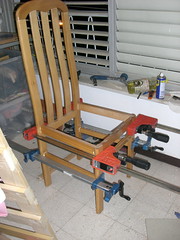
On a personal level, i definitely learnt a lot more about the ideas of De Stijl from building the piece. When all the components were laid out on the floor, it seemed hard to believe that they would eventually constitute a chair (though i must confess, i did have some doubts!). It seemed so...abstract! I wasn't so struck by the design until i started making the piece. Then, and i apologise for the vagueness, i just seemed to fall into the piece; it had some hypnotic effect; the more i looked at it and interacted with it, the more entranced i was. I know that sounds totally fruity, but it's true. I also came away with an appreciation for just how strong the joints are. There--that was a more rational, concrete comment. It was like creating a 3D Mondrian painting. The symmetry of the piece always amazed me; the way the overhang on every intersecting point was the same, and how the piece seemed so mathematically...uniform (I'm easily impressed in maths, since i have little to no understanding of it). Some concepts cannot be conveyed with words, and there is an understanding that you cannot come by through books. Indeed, Rietveld himself regarded his furniture design as experimentation with ideas, as studies. David Pye wrote about this, and for a frequent blog on this topic, Doug Stowe's blog (Wisdom of the Hands) is a must-read. Those interested in the technical execution of the piece can view the building process on this little slideshow:
Friday, 4 June 2010
De Stijl (1917-1931) 'Truth is the Overall Unity of Opposites'
Each inherited a different strand of the earlier movements--the vitalistic, individualistic strand in the case of the Amsterdam School and the rationalist, impersonal strand in the case of De Stijl. Each movement condemned the other, ignoring their shared aims and origins. (Modern Architecture, Oxford History of Art)
Theo van Doesburg (1883-1931)
Piet Mondrian (1872-1944)--some of my friends had no idea he was Dutch based on his surname. It was originally Mondriaan, but he omitted the second 'a' to make himself sound less Dutch. Mission accomplished, i guess.
Gerrit Rietveld (1888-1964)
In 1924, Van Doesburg published the manifesto of De Stijl in the eponymously named magazine he founded with Mondrian and other artists of the movement in 1917. You can read it here. De Stijl rejected craftsmanship, favouring geometrical anti-naturalism, and, according to some, was a misinterpretation and an extreme form of the abstraction of Cubism. But what was up with all the abstraction? Could they just not paint or draw? What were they getting at? Basically, according to Carsten-Peter Warncke, Mondrian, Vantongerloo, van Doesburg, and Huszar were all trying to get back to the basic principles of art; colours, shapes, planes, and lines. They wished to create a metaphorical language, and create an ideal world counter to reality, transcending language barriers. You can see Neo-Platonism's influence on Mondrian's obsession with the purity of art and spirit, and its aim for the absolute. Style was a manifestation of a particular age's attempt to express the absolute. Therefore, Mondrian felt that the best possible style was one in which 'the individual was most strongly subjected to the universal.'
Indeed the contradiction inherent in the movement is summed up by Mondrian himself:
The universal in style must be expressed by the individual, i.e. the way in which style is formed
It remains remarkable that Mondrian should have succeeded in combining the disparate parts of the painting in such a harmonious structure. Again, he could only have achieved this through the multifaceted ambiguity that pervades the various elements of the painting. [...] a perfect harmony of opposites [...] Nothing is fixed in this system , except for the basic elements and the aim of balancing the different forces. This presupposes that all our seemingly secure assumptions should be questioned again and again. (Warncke, p.20)And, in explaining the differences between Mondrian and van Doesburg, we are surely reminded of different poetic schools of thought:
Mondrian's construction of squares and lines is a process that leads to harmony and rest to the extent that we forget everything that might be reminiscent of processes, while van Doesburg's pictures show a completely different approach to dynamics, with colour squares that border on each other harshly and are right next to each other. This dynamic has the rank of an elementary force which can only be tamed with great difficulty and changed in such a way that the well-balanced painting oscillates in its visual impact, paradoxically demonstrating harmony as vibrating restfulness. (Warncke, p.26)Milton and Donne, anyone?
Jakob van Domselaer was the only musician associated with the movement. Here you can listen to his Proeven van Stijlkunst, inspired by Mondrian's paintings
Dada to Pop--cool essay
Artlex Entry on De Stijl
To read De Stijl magazine, click here
Interesting article (or MA thesis) by Runette Kruger about the integrative tendency of the movement, unparalleled in Modern art, in which the artists of De Stijl equally evoked the technological as well as the transcendent as indicators of humanity's spiritual and cultural progress
James Presley-- Mondrian van Doesburg
Sunday, 18 April 2010
Rietveld: Zigzagstoel
Tuesday, 12 January 2010
Miep Gies 1909-2010
Monday, 30 November 2009
Addendum: Thanksgiving & Flemish and Dutch New York
Sunday, 29 November 2009
Dutch-American Heritage Day
Since it was Dutch American Heritage day (16 of November), I just wanted to mention a book I read recently and loved. Russell Shorto’s The Island at the Center of the World. Whenever I go to New York, I always like to hunt around for the remains of New Amsterdam. But it's always hard to find. There are a few monuments and plaques, and some passing references here and there, but i always get the feeling that the story of Dutch America has been short-changed. It makes sense, really. The Dutch do not hold dear their language like the French, nor their pomp like the English. Instead--the infamous red-light district aside--it's a culture of modesty. Everything is diminutive. For instance, glass is a glasje (small glass) and a small glass is doubly small--a kleine glasje. Culturally, the Dutch are almost apologetic, even when people (mostly Americans) have no clue where the Netherlands is or the language spoken there ('do they speak Hollish in Holland?'). I hear Dutch people always preempting this with 'it's a very small country', and other explanations. My personal experience has been the same. I remember my Dutch mother giving up and just saying 'I'm from Europe,' (rolling her eyes, sometimes) after a while. My mother was also more than happy to let the language go with us children, so most of what we know has been self-taught later on in life. My grandparents tried to intercede but not necessarily on behalf of the Dutch language--they wanted my mother to speak to us in her strongest language after Dutch--French (also to no avail)!
Russell Shorto's best-seller saves the Dutch culture of America from being let go. Besides the obvious adage that it is the victors who write history, there are other reasons for the English stranglehold on American history. Shorto humorously explains that American historians found an easier story in Puritan New England than the more rough-and-tumble reality of Dutch Manhattan.
Accounts like that of a woman who, while her husband dozed on a nearby chair, ‘dishonourably manipulated the male member’ of a certain Irishman while two other men looked on. Excessive rigidity (of the moral kind) was not the sin of New Amsterdam’s residents.’ (p. 85)
{Shorto's wit is another great feature of the book. I think the following is the best sentence i have ever come across in a book about history:
The Reverend Jonas Michaelius might well have won a contest for the moodiest, bitchiest resident of New Amsterdam (p. 64)
Phenomenal!}
The historical revisionism of American history is, bluntly put, a conscious decision of total haters with English ancestry. Think i'm being harsh? Shorto brings evidence that nineteenth-century historians considered the Dutch chapter of American history inconsequential at best. Descriptions of the
petty cheeseparing of the Batavian provinces, with their windmills and barren soil, fit only for fuel
are among the kinder references made to the Dutch in nineteenth century American historical surveys.
Shorto instead brings to life Adriaen van der Donck, a young lawyer sent to New Netherland who pushed for the Republican-style government and freedom that became so central to America's cultural heritage. Shorto draws you into his tale by beginning with the work of Charles Gehring, who has worked for over 30 years (and is still going!) translating over 12,000 folios of Dutch colonial records. This book is sweet. Shorto does not divorce New Netherland history from 17th century Dutch history (if you loved Simon Schama's page-turner on the topic you will totes dig this), enriching both in the process. There's also a lot of cool facts to learn. I had no idea that the first kosher butcher on Manhattan Island was a Polish Jew named Asser Levy who stood up to Stuvesant's anti-Semitic wrangling. Want to know who Downing Street was named after? Read the book.
Despite my enthusiasm for this book, there is a huge problem in its premise. Essentially, Shorto makes the argument that the Dutch colony had its roots in thinkers like Grotius and Spinoza; liberals who advocated civil over religious law, in contrast to the witch burning crazy English colonies. To read Grotius as freeing natural law from theology is a dangerous misreading of Grotius at best, and a gross misrepresentation at worst. What follows is the philosophy that the only tolerant society is one that divorces itself from its religious heritage, which diminishes the monumental achievement of the 'tolerant' society of 17th century New Netherland, which was, indeed rooted in theology. That's where Shorto seems to drop the ball. He has us imagining van der Donck studying law at Leiden with Grotius, (which is awesome, granted), but if anything stands out about 17th century Leiden (besides the fact that it was full of Englishman wearing buckled hats and pimp-shoes), it's that the hottest topic of study gripping the place was Hebraism. That is to say, people like Grotius, and later, Selden in England, were defining international and natural law according to rabbinic sources such as the Talmud and Maimonides. A liberal environment, certainly. A Godless one, definitely not.
Thursday, 23 July 2009
Other Stuff the Schippers Were up to During the War
Wednesday, 22 July 2009
For Joost: The Examiner Articles
Thursday, 21 May 2009
שבירה ותיקון
That I may rise, and stand, o'erthrow me, and bend
Your force, to break, blow, burn, and make me new
Well, his Holy Sonnet XIV, as well as classic kabbalistic imagery, which, in keeping with our previous discussions about law, oddly seems to be applied by Launcelot Andrewes in his discussion about the fall of man:
from A Pattern of Catechistical Doctrine (1642)
And also, i suppose, i was thinking of Andrewes's friend Richard Hooker who discusses the concept of 'compatible variety' along similar lines:
A more dutifull and religious way for us were to admire the wisedome of God, which shineth in the bewtifull varietie of all things, but most in the manifold and yet harmonious dissimilitude of those ways (III.xi.8)Click here for Rowan Williams's (the current Archbishop of Canterbury) excellent Richard Hooker Lecture (2005) at the Temple Church, in which he manages to explain, and, perhaps more impressively, apply Hooker's philosophy to modern multi-cultural societies.
Anyway, having established the harmonious
I have my cousin Otto and my uncle Kees to thank for the next step. When i was in Amsterdam a few months ago, i saw a dremel for sale near the Cuyp markt. I totally needed a dremel and told Otto of the price and bits, etc, and headed out and bought it. When i brought it home, i proudly showed it to my cousin Kathelijne and my aunt, Saskia.'
I took this photo to show my parents that i do, indeed, wear safety equipment (Tali, don't mock the headlamp!). Plus, i felt like a dentist. Cool-maybe i'll study dentistry. Although, now that i think of it, i'm not so comfortable with someone operating a rotary tool in my mouth...
One final check
And then the ever-stressful gluing
Tuesday, 5 May 2009
Nationale Bevrijdingsdag 'Liberation Day--Inside Story of Eindhoven Told by Dutch Parents'
Free! Think about it, children! That one can say what one wants; that we are going to have decent papers again and all the rest of it. I am sure that we shall only gradually get used to it.
They are very generous, those English troops. They distribute cigarettes among the population. Those first English cigarettes after all those years! We snatch the English papers from their hands. They just laugh at those people who are so happy with all those very simple things. At the cars which are pulled up at the roadside, groups of children are pushing and hustling and begging the soldiers for their autographs. They are quite willing to give them not once but hundreds of times. I asked one of them how many times had he done that. He answered, ‘Numerous times. Yes, it’s being like Gary Cooper.’
For us this entry has something unreal. Such a mad enthusiasm we had not thought possible. But for the troops, too, this entry must be unforgettable with the radiant evening sun over all those flags and pennants flying from the houses. We have been watching all this together with you, children, and we told you that those men were our friends. At times there were touching moments and one felt a lump rise in one’s throat. Mummy is holding you high, Saskia, and you shake hands with a soldier on top of a huge tank, and very shyly, with a very small voice, you say to him the first words in English you ever spoke, ‘Good luck to you!’ And smiling, the answer comes back, ‘Thanks, kids. We’ll need it.’ Yes, they’ve got to carry on. From the bottom of our hearts we wish them God speed.
When it is quite dark we go home again tired out but happy as never before. With friends we spend the rest of the evening, talking about this gigantic war machine about which we heard so much over the wireless and which at last we were allowed to see with our own eyes.
* 6 years to the date of this publication, the Schippers had another daughter, Celine--my mum.
Monday, 4 May 2009
Donne and Dodenherdenking--the Art of Rememberance Day
But as it is, we have got to wait still for many days. Even Germans dare to come back again, and the notorious murderers of the Gestapo are to be seen again in the streets. We’ve got to be careful again while listening to the news from London. The set was kept in a secret place and using it was a very serious and dangerous affair indeed [...]
After witnessing numerous air battles, news arrives that paratroopers have landed at Son (a small village north of Eindhoven) and have marched to the centre of Eindhoven.
Thursday, 30 April 2009
Brilliant Orange
En Einstein het getal and Einstein the number
En Zeppelin de Zeppelin and Zeppelin the Zeppelin
En Johan zag de bal and Johan the ball
It's not exactly the normal content of this blog, but i've been reading David Winner's Brilliant Orange: The Neurotic Genius of Dutch Football; a fascinating study dealing with conceptions of space, design, architecture, art, and of course, football, in Dutch culture. Winner opens with the following question:
In a manner reminiscent of Wright's Prairie style, Winner goes on to draw connections between the impact of nature on architectural design, and expands into the realm of political philosophy:
‘We tend to think we invented the idea of land-use planning. Our problems with water meant we had to take collective political action in order to be able to build dikes. You can’t do that on your own. We always say that the origin of Dutch democracy lies in this co-operative dike-building’—Maarten Hajer (professor of public policy, University of A’dam), 49
To measure distance is a natural inclination, an instinct for the Dutch people. We measure space quietly, very precisely and then order it in detail. That is the Dutch way of seeing, the Dutch approach to space: selective detail. It’s a natural, instinctive thing for us to do. You see it in our paintings, our architecture and our football too. 53-54