Showing posts with label John Donne. Show all posts

Sunday, 11 July 2010

Revius and Donne: Poets of the Bible

Revius In the past, we have noted the parallel developments in biblical scholarship and politics in the Netherlands and England (link), specifically the Authorised Version and the Statenvertaling. We have also noted the influence of Hugo De Groot (Grotius) on John Milton. Recently, i came across a poem by Jakob Reefsen (Jacobus Revius), a Hebrew scholar who worked on the Statenvertaling and who also composed religious as well as secular poetry. It reminded me of a poem by Donne, and, when taken together, there are some similarities, but overall, Revius' seems like a lesson in how not to write poetry. But i'll let you decide for yourself:

'Hy Droegh Onse Smerten' (1630 in Over-Ysselsche Sangen en Dichten)

T'en sijn de Joden niet, Heer Jesu, die u cruysten,
Noch die verradelijck u togen voort gericht,
Noch die versmadelijck u spogen int gesicht,
Noch die u knevelden, en stieten u vol puysten,

T'en sijn de crijghs-luy niet die met haer felle vuysten
Den rietstock hebben of den hamer opgelicht,
Of het vervloecte hout op Golgotha gesticht,
Of over uwen rock tsaem dobbelden en tuyschten:

Ick bent, ô Heer, ick bent die u dit hebt gedaen,
Ick ben den swaren boom die u had overlaen,
Ick ben de taeye streng daermee ghy ginct gebonden,

De nagel, en de speer, de geessel die u sloech,
De bloet-bedropen croon die uwen schedel droech:
Want dit is al geschiet, eylaes! om mijne sonden.

In English ( i grabbed the translation here):

He carried our sorrows. It is not the Jews
alone, Lord Jesus, that had you crucified;
betraying you, dragging you to the court,
hating your guts, spitting in your face,
binding you, tattooing you with bruises.
Nor only the soldiers
who with their ready fists
raised the reed, lifted the hammer high,
fixed the cursed wood at the place of the skull
and squabbled, dicing for your coat.

It's me, my God, me who did this to you.
I am the heavy tree that bore you down,
the cord that cut you mercilessly. Me.
The nail and spear. The whip they slashed you with.
The crown of blood you wore upon your brow.
Oh, all this happened on account of my own sin.


And here is of course Donne's Holy Sonnet XI (written 1609-1611?):


Spit in my face, you Jews, and pierce my side,
Buffet, and scoff, scourge, and crucify me,
For I have sinn'd, and sinne', and only He,
Who could do no iniquity, hath died.
But by my death can not be satisfied
My sins, which pass the Jews' impiety.
They kill'd once an inglorious man, but I
Crucify him daily, being now glorified.
O let me then His strange love still admire ;
Kings pardon, but He bore our punishment ;
And Jacob came clothed in vile harsh attire,
But to supplant, and with gainful intent ;
God clothed Himself in vile man's flesh, that so
He might be weak enough to suffer woe.


Thursday, 21 May 2009

שבירה ותיקון

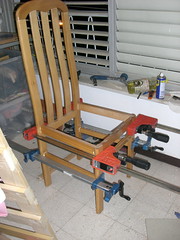
And bend your force, to break, blow, burn, and make me new I got another 'commission', recently, and that was to repair some dining room chairs for some friends. This posting is a little photo journal of the process. I thought it was a bit ironic that in order to fix the chairs, i had to break them. Obviously, i was thinking of Donne:

That I may rise, and stand, o'erthrow me, and bend
Your force, to break, blow, burn, and make me new


Well, his Holy Sonnet XIV, as well as classic kabbalistic imagery, which, in keeping with our previous discussions about law, oddly seems to be applied by Launcelot Andrewes in his discussion about the fall of man:
Text not available

from A Pattern of Catechistical Doctrine (1642)
And also, i suppose, i was thinking of Andrewes's friend Richard Hooker who discusses the concept of 'compatible variety' along similar lines:
A more dutifull and religious way for us were to admire the wisedome of God, which shineth in the bewtifull varietie of all things, but most in the manifold and yet harmonious dissimilitude of those ways (III.xi.8)
Click here for Rowan Williams's (the current Archbishop of Canterbury) excellent Richard Hooker Lecture (2005) at the Temple Church, in which he manages to explain, and, perhaps more impressively, apply Hooker's philosophy to modern multi-cultural societies.

Anyway, having established the harmonious Gross glue in the mortises dissimilitude of the chair pieces, the glue had to be removed from the mortises. See how old and nasty looking the glue is?

I have my cousin Otto and my uncle Kees to thank for the next step. When i was in Amsterdam a few months ago, i saw a dremel for sale near the Cuyp markt. I totally needed a dremel and told Otto of the price and bits, etc, and headed out and bought it. When i brought it home, i proudly showed it to my cousin Kathelijne and my aunt, Saskia.'Cleaning with dremel and chiselIsn't it cute?!' I asked them. They agreed it was indeed a cute little thing with a plethora of cute little bits. But they wanted to know why i was making such a strange (albeit, cute) purchase. 'Oh, everyone needs a dremel, really,' was my reply, which was vigorously backed up by both Otto--'Yes, it's a common tool, and everyone has one' (he has the coolest job ever--restoring buildings) and Kees 'Oh, you can do everything with them' (he is a bronze sculptor). 'Well, what do you do with it?', came the question. Crap, i actually have no idea. Maybe i'll know what to do with it when Otto or Kees explains it. 'Well...you...' [hesitation] 'There are many...' And they both looked at each other, laughed, and admitted that they actually can't quite recall the last time they used their dremels! Anyway, the chisel pictured is one from Otto's grandfather Yeah, i did--the headlamp, baby!(i still need to finish the handle).

I took this photo to show my parents that i do, indeed, wear safety equipment (Tali, don't mock the headlamp!). Plus, i felt like a dentist. Cool-maybe i'll study dentistry. Although, now that i think of it, i'm not so comfortable with someone operating a rotary tool in my mouth...

Scraping glue off the tenonsThe reason for the mask is that when i used the dremel, the glue smelled like a rotting dead animal. For real. There's no way it's hide glue, right? Obviously, the tenons were also covered in old glue, so i sliced off chunks of nasty, smelly glue.

One final check CIMG0854

And then the ever-stressful gluing Actiion shot-glue


And finally, clamping:

Hope it holds!


Monday, 4 May 2009

Donne and Dodenherdenking--the Art of Rememberance Day

The 4th of May, is known in Holland as Dodenherdenking, or War Dead Remembrance. Similar to Israel's Memorial day followed by Independence day, the Dutch have a similar progression. The official, nationally televised commemoration begins in the evening with a service at De Oude Kerk (the Old Church) in central Amsterdam, after which veterans and victims’ relatives lay wreaths at the National War Memorial on nearby Dam square. Church bells ring for a quarter of an hour till 8 pm, when there is a nationwide two-minute silence. Dignitaries and other victims’ groups then lay more wreaths and a child reads out a self-written poem, selected by a local jury. A ceremonial procession past the National War Memorial marks the end of proceedings. As the saying in Holland goes, 'No celebration without commemoration'. This sentiment reflects gratitude, but it also a value placed on the progression of redemption.

We constantly evoke World War II, and the Holocaust with a pledge to prevent further bloodshed. We're not doing so well. I believe that precisely at this fault-line between the fleeting historical awareness of the event, and our collective memory, these rituals may bridge that gap by offering the opportunity for us to experience the redemptive process on an individual, national, and universal level.

When John Donne preached to his congregants, he chose to appeal to them through what he called 'the gallery of the soul'; memory:

Of our perverseness in both faculties, understanding, and will, God may complain, but as much of our memory: for, for the rectifying of the will, the understanding must be rectified; and that implies great difficulty: But the memory is so familiar, and so present, and so ready a faculty, as will always answer, if we but speak to it, and aske it, what God hath done for us, or for others. The art of salvation, is but the art of memory.

In preparation for liberation day, and in honour of remembrance day, the following are extracts from a memoir which was published in the English paper The Examiner in April of 1945. The diary was written by JHT Schipper (my grandfather) for his two children Saskia and Jan. Schipper translated these extracts for John and Maureen Jones, the children of Alfred Wynn Jones, a member of the Balloon Barrage who was stationed in Eindhoven, as an expression of the friendship that developed between them. Sentences in orange are my own.

On the 18th of September, 1944, the town of Eindhoven was liberated by the second British Army after more than four years and four months of German oppression. That is something you ought to know; that is worth while recording in this book […] When you, in years to come, have to study from your school books the history of this war and you are able to form for yourself a rough idea of these dramatic happenings you will understand something of what we felt as that long-awaited day of liberation, which was anything but a mere phase, at last dawned. It was the day for which we had been longingly looking out for four long years, a day on which we (probably for the first time,) could realise fully what it means to get rid of a more than brutal and inhuman oppressor […]

One doesn't dare to go out in the streets. The Germans steal bicycles all over the city. During the night, you would hear gun-fire in the distance. During day-time the offices are practically empty. One tries to collect as much food as possible and then suddenly without pause we see German troops withdrawing and over the wireless they go on talking about the bitter fighting on the Belgian-Dutch frontier.

After the Germans and Dutch Nazis flee the town, it seems as if the English will arrive shortly

But as it is, we have got to wait still for many days. Even Germans dare to come back again, and the notorious murderers of the Gestapo are to be seen again in the streets. We’ve got to be careful again while listening to the news from London. The set was kept in a secret place and using it was a very serious and dangerous affair indeed [...]

Time goes slowly…Nobody seems to know anything better to do than to dig ditches in the garden and listen to the news from London…

After witnessing numerous air battles, news arrives that paratroopers have landed at Son (a small village north of Eindhoven) and have marched to the centre of Eindhoven.


This situation for us who live in the southern part of the town is then very peculiar. Practically the whole town is in the hands of the American paratroopers but we haven’t seen anything of it at all, and we know the Germans are still all around us. In little groups they (the Germans) pass by our houses, rifles and hand grenades at the ready. Curious idea to find yourself all of a sudden more or less in the front line while we are having our meals and the children, quite unconscious of the dangers around them, are playing in the garden.

People in the town are euphoric and celebrating liberation; it turns out to be premature. The Schippers are warned to take their flags in for the Germans are still quite near.

In these hours of waiting we have put more than a thousand times the question, 'When will the English come in from the south?' Tormenting was the news that they had captured the small town of Valkenswaard, a few miles to the south and were staying there. Why did they not march on? Where are they now?

Tuesday, 31 March 2009

John Donne Commemoration; Woodworking, Wit, and ADD


This image was taken from Digital Donne--a great online source for digital images of Donne's manuscripts and early editions

Ah, John Donne. Today, 31 March, is set aside for him by the Church of England. However, due to holiday schedules colliding, i think St. Joseph knocked Donne off the calendar this year. Personally, i think the guy should get a month, forget a day. Sometimes i think this blog takes the form of the Anglican calendar, oddly. For an article on another Jewish girl who likes Donne, click here. For a short bio from Wikipedia, click here. To see Donne's recent makeover, click here.

What can one possibly say about Donne that hasn't already been said? Well, i'll have a crack at it. Firstly, the guy was totally ADD. If he wasn't, his expression of the natural difficulty with which many of us struggle whilst at prayer makes me like him even more:

I throw myself down in my Chamber, and I call in, and invite God, and his Angels thither, and when they are there, I neglect God and his Angels, for the noise of a fly, for the rattling of a coach, for the whining of a door. . .A memory of yesterday’s pleasures, a fear of tomorrows dangers, a straw under my knee, a noise in mine ear, a light in mine eye, an anything, a nothing, a fancy, a Chimera in my brain, troubles me in my prayer. So certainly is there nothing, nothing in spiritual things, perfect in this world.

I think that's what most people like about Donne; he was so human, so accessible. Milton seems to constantly boom down at you from on high, but Donne seems to be struggling with all the other mortals.

Donne has this way of perceiving the world which seems to transcend the human perspective. Here is a section of a letter he wrote to Lady Kingsmel upon the death of her husband on the 26 October 1624:

Nothing disproportions us, nor makes us so incapable of being reunited to those whom we loved here, as murmuring, or not advancing the goodness of Him, who hath removed them from hence. We would wonder, to see a man, who in a wood were left to his liberty, to fell what trees he would, take onely the crooked, and leave the streightest trees; but that man hath perchance a ship to build, and not a house, and so hath use of that kinde of timber: let not us, who know that in Gods house there are many Mansions, but yet have no modell, no designe of the forme of that building, wonder at His taking in of his materials, why he takes the young, and leaves the old, or why the sickly overlive those, that had better health.

True, it doesn't always do the trick, but when you are struggling with the idea of death or dealing with the death of family or friends, this analogy gives you pause. We tend to blame God; Donne asserts that this distances us from the dead. The metaphor he uses for a craftsman who needs different woods for different purposes is great, too.

Here's another section of God as a craftsman. It reminds me of the poem כי הנה כחומר, in the Jewish liturgy of the High Holy Days. To hear the prayer in about 9 different versions, click here.

When Man was fallen, God clothed him, made him a leather garment; there god descended to one occupation. When the time of Man's redemption was come, then God, as it were, to house him, became a carpenter's son; there God descended to another occupation. Naturally, without doubt, Man would have been his own tailor and his own carpenter; something in these kinds Man would have done of himself, though he had no pattern from God. But . . . in preserving Man from perishing in the Flood, God descended to a third occupation, to be his shipwright, to give him the model of a ship, an Ark, and so to be the author of that, which man himself in likelihood would never have thought of, a means to pass from nation to nation.
from A Sermon . . . Preached to the Honorable Company of the Virginia Plantation, 13 November 1622

Finally, in the vein of Rosh Hashana, or the High Holy Days, i'll close with a great piece by Donne on the nature of sin, called 'A Hymn to God the Father':


WILT Thou forgive that sin where I begun,
Which was my sin, though it were done before?
Wilt Thou forgive that sin, through which I run,
And do run still, though still I do deplore?
When Thou hast done, Thou hast not done,
For I have more.


Wilt Thou forgive that sin which I have won
Others to sin, and made my sin their door?
Wilt Thou forgive that sin which I did shun
A year or two, but wallowed in a score?
When Thou hast done, Thou hast not done,
For I have more.


I have a sin of fear, that when I have spun
My last thread, I shall perish on the shore ;
But swear by Thyself, that at my death Thy Son
Shall shine as he shines now, and heretofore ;
And having done that, Thou hast done ;
I fear no more.