Showing posts with label Poetry. Show all posts

Sunday, 11 July 2010

Revius and Donne: Poets of the Bible

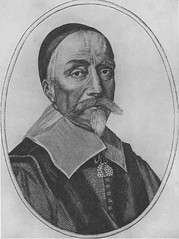
Revius In the past, we have noted the parallel developments in biblical scholarship and politics in the Netherlands and England (link), specifically the Authorised Version and the Statenvertaling. We have also noted the influence of Hugo De Groot (Grotius) on John Milton. Recently, i came across a poem by Jakob Reefsen (Jacobus Revius), a Hebrew scholar who worked on the Statenvertaling and who also composed religious as well as secular poetry. It reminded me of a poem by Donne, and, when taken together, there are some similarities, but overall, Revius' seems like a lesson in how not to write poetry. But i'll let you decide for yourself:

'Hy Droegh Onse Smerten' (1630 in Over-Ysselsche Sangen en Dichten)

T'en sijn de Joden niet, Heer Jesu, die u cruysten,
Noch die verradelijck u togen voort gericht,
Noch die versmadelijck u spogen int gesicht,
Noch die u knevelden, en stieten u vol puysten,

T'en sijn de crijghs-luy niet die met haer felle vuysten
Den rietstock hebben of den hamer opgelicht,
Of het vervloecte hout op Golgotha gesticht,
Of over uwen rock tsaem dobbelden en tuyschten:

Ick bent, ô Heer, ick bent die u dit hebt gedaen,
Ick ben den swaren boom die u had overlaen,
Ick ben de taeye streng daermee ghy ginct gebonden,

De nagel, en de speer, de geessel die u sloech,
De bloet-bedropen croon die uwen schedel droech:
Want dit is al geschiet, eylaes! om mijne sonden.

In English ( i grabbed the translation here):

He carried our sorrows. It is not the Jews
alone, Lord Jesus, that had you crucified;
betraying you, dragging you to the court,
hating your guts, spitting in your face,
binding you, tattooing you with bruises.
Nor only the soldiers
who with their ready fists
raised the reed, lifted the hammer high,
fixed the cursed wood at the place of the skull
and squabbled, dicing for your coat.

It's me, my God, me who did this to you.
I am the heavy tree that bore you down,
the cord that cut you mercilessly. Me.
The nail and spear. The whip they slashed you with.
The crown of blood you wore upon your brow.
Oh, all this happened on account of my own sin.


And here is of course Donne's Holy Sonnet XI (written 1609-1611?):


Spit in my face, you Jews, and pierce my side,
Buffet, and scoff, scourge, and crucify me,
For I have sinn'd, and sinne', and only He,
Who could do no iniquity, hath died.
But by my death can not be satisfied
My sins, which pass the Jews' impiety.
They kill'd once an inglorious man, but I
Crucify him daily, being now glorified.
O let me then His strange love still admire ;
Kings pardon, but He bore our punishment ;
And Jacob came clothed in vile harsh attire,
But to supplant, and with gainful intent ;
God clothed Himself in vile man's flesh, that so
He might be weak enough to suffer woe.


Monday, 28 June 2010

The Character of Holland...According to the English

In a previous post, we have referred to English hatred of the Dutch, and it's no secret that during the Anglo-Dutch Wars, the English launched some pretty nasty anti-Dutch propaganda that would have made Goebbels proud. Below is a poem by Andrew Marvell (1621-1678), a friend of Milton's in the service of Cromwell. It's pretty rude, but some of it is quite funny! Lest any Dutchies get offended, Marvell also used anti-Semitic stereotypes to berate his opponent, Samuel Parker:
who but such an Hebrew Jew as you, would, after an honest man hade made so full and voluntary Restitution, not yet have been satisfied without so many pounds of his flesh over into the bargain.
This is actually in the context of a debate rooted in Hebraism, so the insults get way more interesting than that (check out Rosenblatt's book on Selden, chapter 5).

Unsurprisingly, in the early modern period, religion was a source of conflict. The English disapproved of the Dutch pluralistic society, which was rooted in Republican sensibilities; this disregard for order and hierarchy was dangerous. The Dutch took the reformist call for personal autonomy in interpreting Scripture too far:
They are generally so bred up to the Bible that almost every Cobbler is a Dutch doctor of divinity...yet fall those inward illuminations so different that sometimes seven religions are found in one family.' (Schama)
And finally, here is the poem. Incidentally, if you're Dutch and Jewish, well, Marvell will offend you in one form or another! ;-)


Thursday, 15 October 2009

The Debate of the Carpenter's Tools


Below is the famous late fifteenth century poem depicting the tools of a carpenter engaged in debate. I was determined to find it when i read a blog post by Christopher Schwarz that mentioned this poem in passing as being included in an older book by Roy Underhill. For a helpful introduction to the poem, click here. Below is the brief forward by James Orchard Halliwell from his 1844 edition of the poem, included in the volume Nugae Poetica: Select Pieces of Old English Popular Poetry, Illustrating the Manners and Arts of Fifteenth Century. I think the title of his book is longer than his little blurb on our poem, but here it is for your enjoyment.
Addendum: Since scrolling all the way down for the footnotes is a royal pain, they're included after every relevant page, but i decided to leave the entire list at the bottom, as well.


1 Shype-Ax. Most likely an ax used for chipping or trimming. See MED, “chip-ax.”

3 Clene hose and clene schone. The sense of these lines appears to be “I will earn you food and drink, but you’ll have to work harder to earn yourself clothing.”

6 Thall. “Thou will.” See MED, “thou.”

7 longys the crafte. Crafte may here refer to the profession of carpenters in general, or the local craft guild of carpenters more specifically.

9 Belte. An “allet maul, hammer; also, a bat or club.” See MED, “betel.”

13 Twybyll. A “kind of ax with two cutting edges; formerly used for cutting mor tices”; see OED, “twibill,” 1.

17 Wymbyll. A name applied to several different kinds of boring tools; see OED, “wimble.”

22 twenti pounde. This is an outlandish sum, perhaps double the amount of an ex perienced master carpenter’s yearly wages.


31 Groping-Iren. A chisel or gouge.

43 ale-wyffe. Brewing ale was a common household industry for women.

48 twenti merke. A mark was two-thirds of a pound; since the Whetstone is speaking of yearly wages, this boast seems more plausible.

53 Adys. An adze is an ax-like tool with a curved blade, used for cutting away wood.

77 seven pens drynke. Seven pence, the rough equivalent of a carpenter’s daily wages, would purchase up to seven gallons of ale (depending on its strength), a comic ally extravagant amount.

79 Lyne and the Chalke. Strings coated in chalk are still used by carpenters for drawing lines on wood to be cut.

87 Prykyng Knyfe. MED and OED quote only this line; if not an awl, this tool is likely to be some other instrument for marking wood.

93 Persore. “An awl, a gimlet, an auger”; see MED, “percer(e).” Lines 100–04 sug gest that this is a drill.

106 schyreff of the toune. Sheriffs originally had considerable local authority in admin istering the royal legal system, but by the later Middle Ages, their impor tance had waned. Nevertheless, the job was typically held by minor gentry, and being ap pointed sheriff would be an honor considerably beyond the hopes of carpenters.

107 Skantyllyon. A gauge, used for measuring the depth of mortises (recesses made in wood for joinery).

120 drynke never peny. A penny’s worth of ale might vary between one-third and one gallon.

139 Brode-Ax. Salzman describes this as “made with a chisel edge, beveled only on one side, which enabled it to follow a marked line accurately” (Building in England, p. 342).

145 Twyvete. Uncertain. OED suggests that this is a double-edged axe, via an etymology endorsed by Wilson (“Debate of the Carpenter’s Tools,” p. 406). Salzman argues plausibly that the tool is a mallet (Building in England, p. 344).

162 a knyght. Though late medieval knighthood was a marker of wealth rather than birth, carpenters would have been extremely unlikely to rise to this rank. The Windlass’s disbelief in lines 167–68 is entirely justified.

163 Wyndas-Rewle. A windlass is an axle or roller used for winding or moving.
179 The devyles dyrte. This expression appears in the Towneley Plays, in the Play of the Buffeting, ed. England, p. 233, line 170. The sense of the insult is “something wretched or excremental.”

183 This seven yere. The customary duration of an apprenticeship.

199 Nother the mayster ne the man. I.e., “neither the master nor his apprentices and journeymen.”

221 Draught Nayle. Uncertain. MED and Salzman suggest that this is a punch for countersinking nails (Building in England, p. 345). Wilson argues that the etymol ogy favors the interpretation of the phrase as a nail-drawer (“Debate of the Carpen ter’s Tools,” p. 468).

279 hym that it dud make. See the introduction to this item.

Item 16, THE DEBATE OF THE CARPENTER’S TOOLS: FOOTNOTE

1 If he ever thrives, then he bears himself well [Presumably ironic]


Item 16, THE DEBATE OF THE CARPENTER’S TOOLS: EXPLANATORY NOTES

Abbreviations: MED: Middle English Diction ary; OED: The Oxford English Dictionary;

Title No title or incipit. Halliwell, the poem’s first editor, gave the poem this title, which has been favored in subsequent references. The text begins one-quarter down the page of fol. 23r, with no space separating it from the previous item.

1 Shype-Ax. Most likely an ax used for chipping or trimming. See MED, “chip-ax.”

3 Clene hose and clene schone. The sense of these lines appears to be “I will earn you food and drink, but you’ll have to work harder to earn yourself clothing.”

6 Thall. “Thou will.” See MED, “thou.”

7 longys the crafte. Crafte may here refer to the profession of carpenters in general, or the local craft guild of carpenters more specifically.

9 Belte. An “allet maul, hammer; also, a bat or club.” See MED, “betel.”

13 Twybyll. A “kind of ax with two cutting edges; formerly used for cutting mor tices”; see OED, “twibill,” 1.

17 Wymbyll. A name applied to several different kinds of boring tools; see OED, “wimble.”

22 twenti pounde. This is an outlandish sum, perhaps double the amount of an ex perienced master carpenter’s yearly wages.

31 Groping-Iren. A chisel or gouge.

43 ale-wyffe. Brewing ale was a common household industry for women.

48 twenti merke. A mark was two-thirds of a pound; since the Whetstone is speaking of yearly wages, this boast seems more plausible.

53 Adys. An adze is an ax-like tool with a curved blade, used for cutting away wood.

77 seven pens drynke. Seven pence, the rough equivalent of a carpenter’s daily wages, would purchase up to seven gallons of ale (depending on its strength), a comic ally extravagant amount.

79 Lyne and the Chalke. Strings coated in chalk are still used by carpenters for drawing lines on wood to be cut.

87 Prykyng Knyfe. MED and OED quote only this line; if not an awl, this tool is likely to be some other instrument for marking wood.

93 Persore. “An awl, a gimlet, an auger”; see MED, “percer(e).” Lines 100–04 sug gest that this is a drill.

106 schyreff of the toune. Sheriffs originally had considerable local authority in admin istering the royal legal system, but by the later Middle Ages, their impor tance had waned. Nevertheless, the job was typically held by minor gentry, and being ap pointed sheriff would be an honor considerably beyond the hopes of carpenters.

107 Skantyllyon. A gauge, used for measuring the depth of mortises (recesses made in wood for joinery).

120 drynke never peny. A penny’s worth of ale might vary between one-third and one gallon.

139 Brode-Ax. Salzman describes this as “made with a chisel edge, beveled only on one side, which enabled it to follow a marked line accurately” (Building in England, p. 342).

145 Twyvete. Uncertain. OED suggests that this is a double-edged axe, via an etymology endorsed by Wilson (“Debate of the Carpenter’s Tools,” p. 406). Salzman argues plausibly that the tool is a mallet (Building in England, p. 344).

162 a knyght. Though late medieval knighthood was a marker of wealth rather than birth, carpenters would have been extremely unlikely to rise to this rank. The Windlass’s disbelief in lines 167–68 is entirely justified.

163 Wyndas-Rewle. A windlass is an axle or roller used for winding or moving.

179 The devyles dyrte. This expression appears in the Towneley Plays, in the Play of the Buffeting, ed. England, p. 233, line 170. The sense of the insult is “something wretched or excremental.”

183 This seven yere. The customary duration of an apprenticeship.

199 Nother the mayster ne the man. I.e., “neither the master nor his apprentices and journeymen.”

221 Draught Nayle. Uncertain. MED and Salzman suggest that this is a punch for countersinking nails (Building in England, p. 345). Wilson argues that the etymol ogy favors the interpretation of the phrase as a nail-drawer (“Debate of the Carpen ter’s Tools,” p. 468).

279 hym that it dud make. See the introduction to this item.


Item 16, THE DEBATE OF THE CARPENTER’S TOOLS: TEXTUAL NOTES

Abbreviations: see Explanatory Notes

1 MS: Initial T is two lines tall.

4 wheresoever. MS: wherasever.

8 nothyng. MS: nothnyng.

12 clothe and fede. MS: clothe fede.

41 dey and nyght. MS: dey nyght.

82 thryve. MS: thryv.

124 hym owght. MS: hy owght.

183 prentys. MS: puntys.

224 mayster. MS: maystys.

237 wyrke not. MS: wyrke no.

245 Groping Iren. MS: iren is added above the rest of the line.

268 off. MS: of.

279 gest. MS: yet. Wilson’s emendation.